
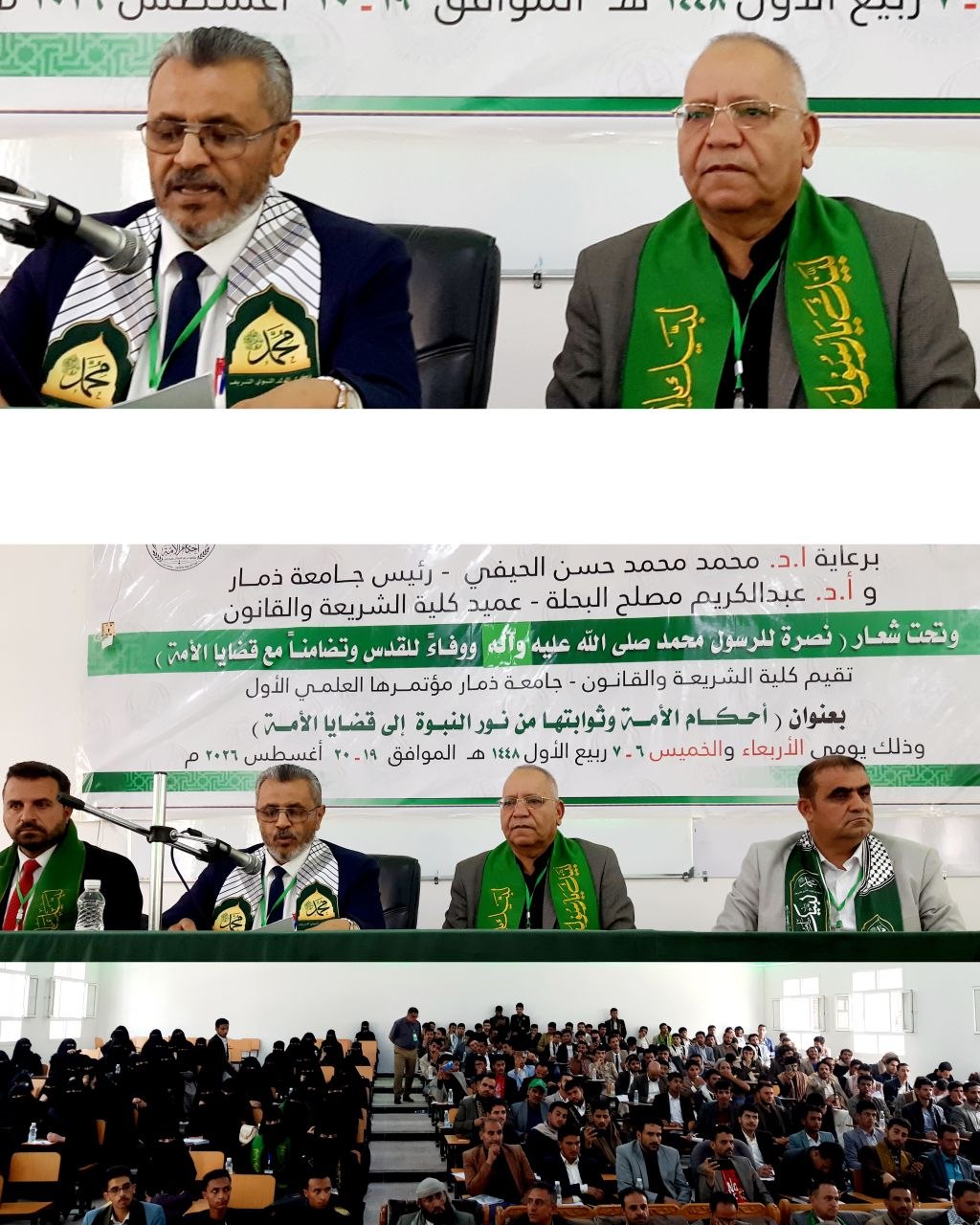
The First Scientific Conference of the Faculty of Sharia and Law at Thamar University Adopts Scientific Recommendations to Enhance Sharia and Legal Research on Issues Facing the Muslim Community
The First Scientific Conference of the Faculty of Sharia and Law at Thamar University Adopts Scientific Recommendations to Enhance Sharia and Legal Research on Issues Facing the Muslim Community
□ Thamar University Media | Rabi Al-Awwal 7, 1448. August 20, 2026
■ The First Scientific Conference of the Faculty of Sharia and Law at Thamar University concluded its proceedings today, Thursday, with the adoption of eleven scientific and research recommendations. These recommendations reflect the most prominent insights and discussions that emerged from its sessions regarding contemporary Sharia, Maqasid (objectives of Islamic law), legal, intellectual, and media issues.
The conference was held under the title "The Rulings and Constants of the Muslim Community: From the Light of Prophethood to the Issues Facing the Muslim Community," and was sponsored by Professor Dr. Mohammed Mohammed Hassan Al-Haifi, the Rector of Thamar University.
The recommendations are the fruit of the studies and peer-reviewed research presented by academics, researchers, and judges, as well as the discussions and interventions that took place during the conference sessions. They stem from the importance of connecting Sharia rulings and Prophetic constants to the issues facing the Muslim community and its current developments, and of activating the role of scientific research in providing fundamental and practical solutions to the issues addressed by the conference.
The scientific recommendations included a focus on the occasion of the Prophet's birthday, his biography, and the ethical values of the Prophet Mohammed (peace and blessings be upon him and his family). The conference recommended utilizing the occasion of the Prophet's birthday and the study of his biography to strengthen love for the Prophet (peace and blessings be upon him and his family) and to encourage emulation of his example. It also recommended instilling ethical and faith-based values in educational curricula, religious discourse, and media, while adhering to Islamic legal principles.
The conference emphasized the importance of strengthening legal and religious studies related to the Palestinian cause. It recommended documenting the violations committed against the Palestinian people and utilizing the principles of international law and international humanitarian law to highlight legitimate rights and counter the distortion of facts. This would enhance the role of academic research in documenting violations and defending legitimate rights.
Regarding responsibility towards affected communities, the conference recommended activating the religious and humanitarian responsibility towards these communities by supporting them according to priorities and needs. It also recommended diversifying the areas of support to include relief, scientific, media, and legal aspects, in order to respond to their needs and enhance the contribution of academic and community institutions in supporting them.
The conference also recommended adopting the jurisprudence of balancing interests and the objectives of Islamic law as a methodology for addressing the issues and challenges facing the Muslim community. It further recommended encouraging applied studies that translate theoretical foundations into practical, evaluable standards, thereby enhancing the ability of Islamic legal studies to address emerging and complex issues from a balanced, scholarly perspective.
Regarding technological advancements, the conference recommended establishing legal, ethical, and Sharia-compliant guidelines for the use of artificial intelligence and modern technologies in armed conflicts. These guidelines should safeguard the rights of civilians, strengthen accountability for the consequences of their use, and keep pace with rapid technological developments and the challenges they pose to legal and Sharia systems.
The conference emphasized the importance of interdisciplinary studies and joint scientific projects between Sharia, law, media, international relations, and modern technologies. This will enhance the comprehensive approach to addressing the issues and challenges facing the Muslim community and expand the scope of scientific cooperation across different disciplines.
The conference also recommended activating cultural and documentary media to serve the nation's causes by producing purposeful historical films, programs, and series, and linking current events to the Prophet's biography and Islamic history. This would enhance public awareness and provide a conscious media and cultural approach to the nation's issues and history.
In the area of capacity building, the conference recommended encouraging the development of the scientific and technological capabilities necessary to protect the nation's interests, supporting research, development, and innovation, leveraging contemporary experiences and expertise to build independent national capabilities, and strengthening the presence of academic institutions in the fields of knowledge, technology, and innovation.
At the college and conference levels, participants recommended establishing a scientific committee to follow up on the conference's outcomes and recommendations, transforming priorities into research initiatives, projects, and scientific programs, and monitoring progress to ensure the continuity of work on the outcomes and prevent them from remaining merely theoretical recommendations.
The conference also recommended publishing its research and recommendations in a peer-reviewed scientific publication and making them available electronically. It further recommended that academic departments utilize these findings in their future research plans, ensuring the documentation of the conference's scientific output and making the knowledge it generated accessible to researchers and those interested.
The conference called for strengthening research partnerships with universities, centers, and scientific, legal, and media institutions to exchange expertise, conduct joint research, expand areas of academic cooperation, and enhance integration among institutions and disciplines relevant to the issues facing the nation.
In its concluding recommendations, the conference emphasized that these outcomes represent a starting point for ongoing scholarly work, and that the impact of scientific conferences is measured by their ability to translate research and discussion results into measurable and evaluable programs, projects, and initiatives. This reinforces the mission of the College of Sharia and Law to combine the authenticity of rulings and established principles with an awareness of current realities and developments, and to contribute to addressing the nation's issues with knowledge, sound scholarship, and a sense of responsibility.