
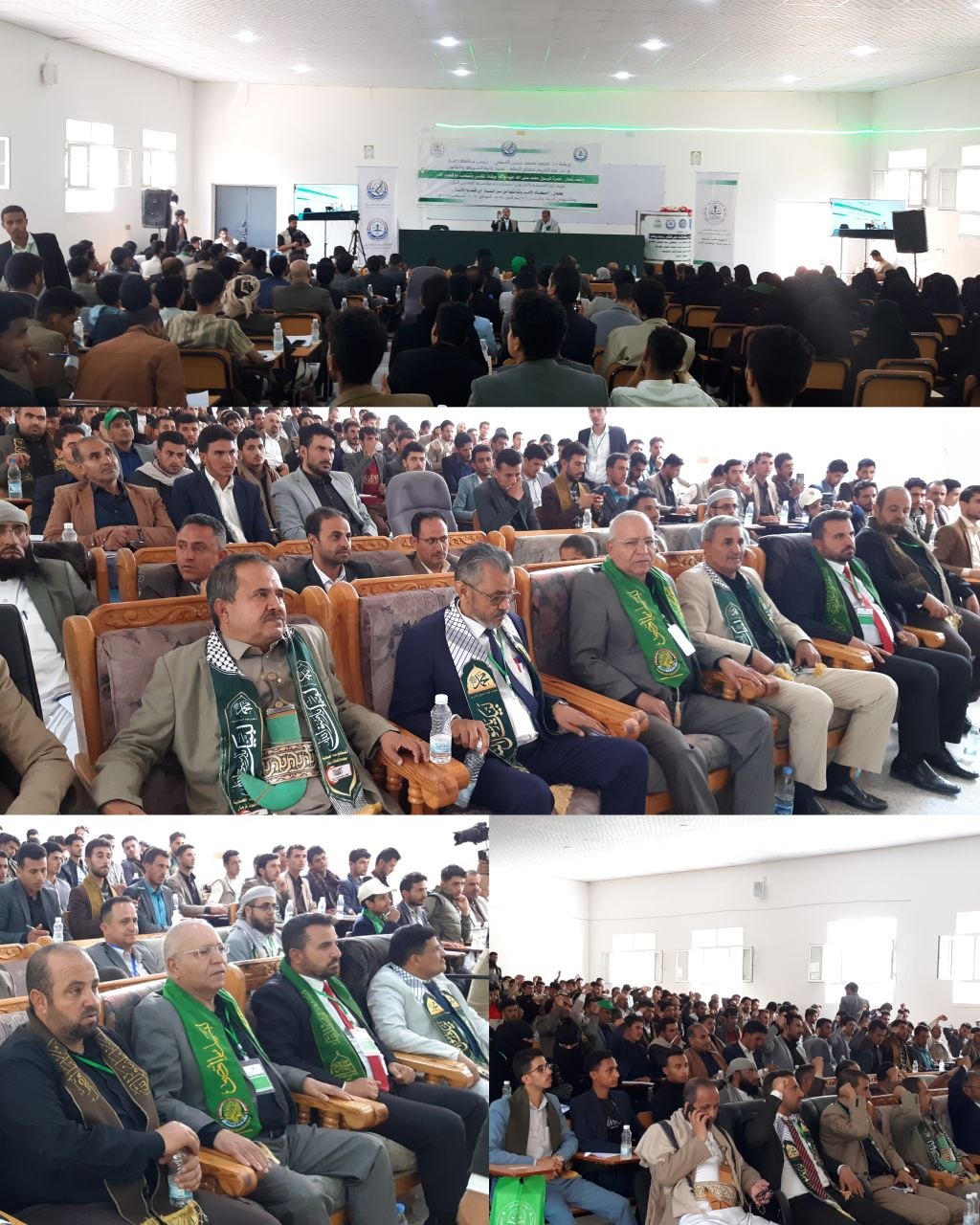
The First Scientific Conference of the Faculty of Sharia and Law at Thamar University Concludes and its Success is Declared
The First Scientific Conference of the Faculty of Sharia and Law at Thamar University Concludes and its Success is Declared
□ Thamar University Media | Rabi Al-Awwal 7, 1448. August 20, 2026
◼️The Faculty of Sharia and Law at Thamar University concluded its first scientific conference, entitled "The Rulings and Constants of the Nation: From the Light of Prophethood to the Issues of the Nation," on Thursday. The two-day conference was held under the patronage of Professor Dr. Mohammed Mohammed Hassan Al-Haifi, the Rector of Thamar University, and with the participation of a select group of academics, researchers, judges, and specialists, coinciding with the commemoration of the Prophet's birthday.
The conference concluded after the completion of its scientific sessions, the review and discussion of accepted research papers within its various themes. These papers addressed a range of contemporary Sharia, Maqasid (objectives of Islamic law), legal, intellectual, and media issues. The conference explored ways to connect Sharia rulings and Prophetic constants with the issues and developments facing the nation, and to activate the role of scientific research in addressing these issues in a fundamental and practical manner.
In the closing session, Professor Dr. Abdulkareem Al-Bahla, The Dean of the College of Sharia and Law and Chairman of the Conference, read the conference's final statement. This statement reviewed the most prominent outcomes of the conference and the scholarly recommendations that emerged from its sessions. These recommendations focused on strengthening Sharia and legal studies related to the issues facing the Muslim community, activating responsibility towards afflicted societies, employing the jurisprudence of balancing interests and objectives in addressing contemporary challenges, establishing Sharia, legal, and ethical frameworks for the use of modern technologies and artificial intelligence, and supporting interdisciplinary studies, research partnerships, and the development of scientific and technical capabilities.
The conference recommendations also included an emphasis on following up on its outcomes and translating its priorities into scientific initiatives, projects, and programs. They further recommended publishing the research in a peer-reviewed scholarly journal and making it available electronically, as well as strengthening partnerships with universities, centers, and scientific, legal, and media institutions.
The final statement affirmed that the conference's outcomes represent a starting point for ongoing scholarly work. This work reinforces the mission of the College of Sharia and Law to combine the authenticity of rulings and established principles with an awareness of current realities and developments, and to contribute to addressing the issues facing the Muslim community through scholarship, sound scholarship, and a sense of responsibility.
In his closing remarks, Professor Dr. Mohammed Mohammed Hassan Al-Haifi, the Rector of Thamar University, congratulated the attendees on the success of the conference, praising the high level of scholarly and research participation and the rich discussions. He commended the efforts of the Faculty of Sharia and Law, the organizing committee, the researchers, and all participants in making this academic event a success, and officially declared the first conference concluded.
On this occasion, the University Rector announced his aspiration to hold the second scientific conference of the Faculty of Sharia and Law at the same time next year, on a larger scale and with broader national participation. This, he emphasized, would enhance the conference's scholarly and research impact, building upon the achievements of the first conference and developing its themes and outcomes, coinciding with the commemoration of the Prophet's birthday.
The conference concluded with an affirmation of Thamar University's continued support for scientific research and academic conferences, and its commitment to strengthening the role of the Faculty of Sharia and Law in producing specialized knowledge and connecting Sharia and legal studies to the issues and developments facing society and the nation.