
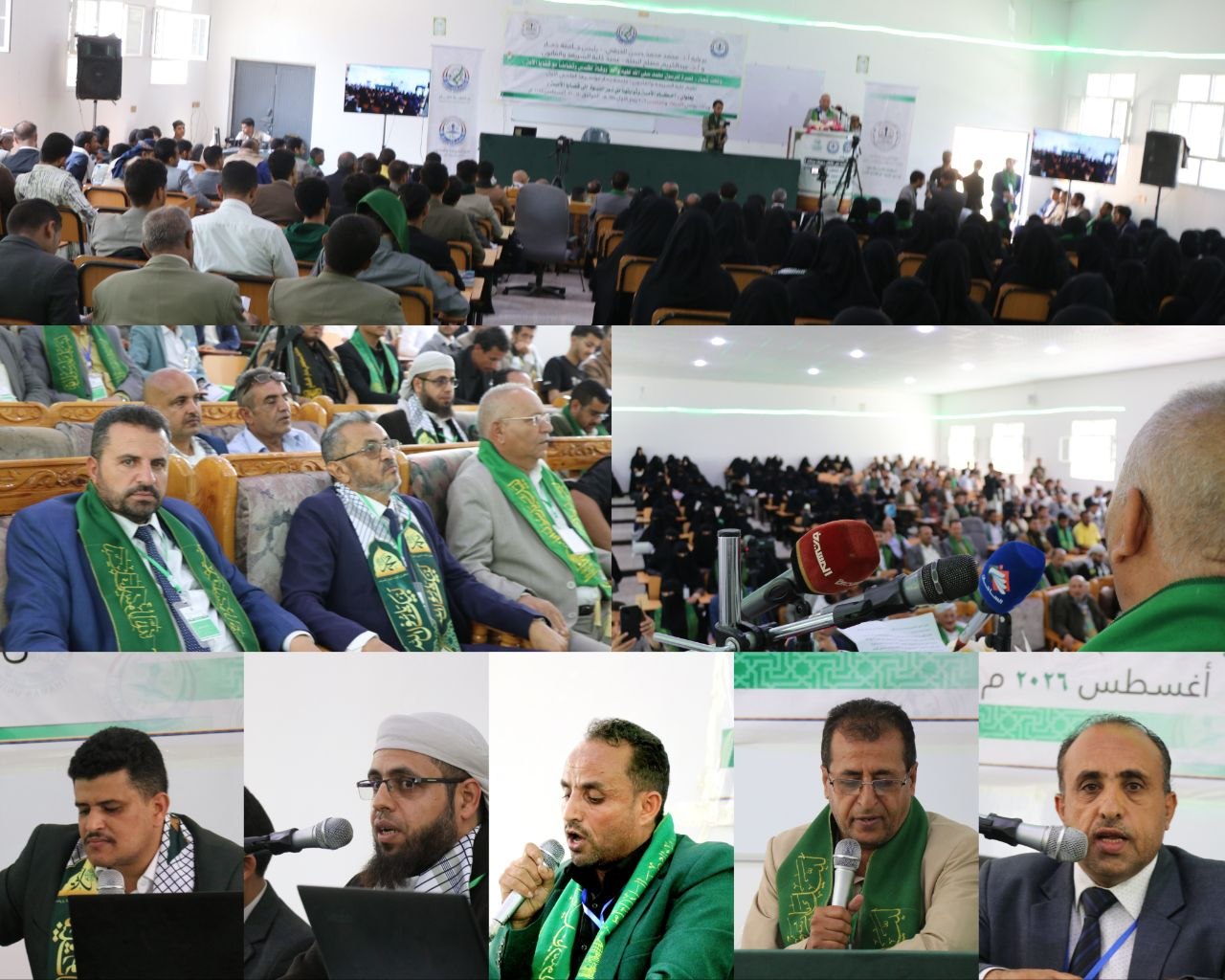
On the First Day of the Sharia and Law College Conference at Thamar University, Rigorous Scholarly Research Examines the Sharia and Legal Foundations of the Nation's Issues
On the First Day of the Sharia and Law College Conference at Thamar University, Rigorous Scholarly Research Examines the Sharia and Legal Foundations of the Nation's Issues.
□ Thamar University Media | Rabi Al-Awwal 6,1448. August 19, 2026
■ Following the opening session, the first scientific conference, entitled "The Nation's Rulings and Constants: From the Light of Prophethood to the Nation's Issues," continued today, Wednesday, at the Sharia and Law College, Thamar University.
The conference, sponsored by Professor Dr. Mohammed Mohammed Hassan Al-Haifi, the Rector of Thamar University, featured scholarly research sessions that discussed a range of Sharia, legal, and intellectual issues related to the Prophet's birthday and contemporary issues facing the nation. A select group of academics, judges, and researchers participated.
The conference comes within the framework of Thamar University's commitment to promoting scientific research in addressing religious, national, and humanitarian issues, and to providing an academic platform for researchers to present studies grounded in Islamic jurisprudence and legal analysis. These studies draw upon the light of Prophethood and its values in understanding the challenges facing the Muslim community, thus contributing to the enrichment of specialized knowledge and strengthening the connection between academic studies and contemporary reality.
The first day's proceedings opened with discussions of several scholarly papers covering a range of topics, including Islamic jurisprudence and its objectives, legal studies, issues of responsibility towards the vulnerable, the jurisprudence of balancing competing interests, and the role of Prophetic ethical values in developing contemporary Islamic media discourse.
In this context, Professor Dr. Hamoud Mohsen Qassem Al-Mulaiki presented a paper entitled "The Sharia and Objective Foundations of Commemorating the Prophet's Birthday: An Analytical Study." In it, he addressed the Sharia and objective foundations associated with commemorating the Prophet's birthday, within an analytical framework that aimed to explore the religious and objective significance of this occasion and to elucidate its related meanings and values.
Dr. Bashir Ali Ali Qaddoum presented a paper titled “The Legal Implications of Israel’s Militarization: Artificial Intelligence, Gaza and Iran as Case Studies,” addressing the legal dimensions related to the deployment of military capabilities and modern technologies, with a focus on artificial intelligence and its applications in the context of events in Gaza and Iran, and the legal and ethical challenges these developments raise.
Dr. Ahmed Abdullah Salah, in his paper “The Image of Neglect in Muslims’ Responsibility to Support the Oppressed: The Palestinian People as a Case Study,” addressed the issue of responsibility towards oppressed peoples, using Palestinian people as a model to examine the manifestations of negligence in fulfilling this responsibility and its resulting legal and ethical dimensions.
Similarly, Dr. Aref Ahmed Mohammed Malhi presented a paper titled “The Legitimacy of Supporting Afflicted Societies in Light of the Jurisprudence of Balancing,” which explored the legitimacy of supporting societies facing crises and hardships through an approach based on the jurisprudence of balancing interests. This approach considers benefits and harms and establishes responsibility towards affected societies in light of relevant jurisprudential principles.
The research presented on the first day concluded with a paper by Dr. Ali Mohammed Quradha entitled “Prophetic Ethical Values and Their Application in Enhancing Contemporary Islamic Media.” This paper addressed the system of ethical values derived from the Prophet’s teachings and their potential application in developing contemporary Islamic media, enhancing its message, content, and performance amidst the transformations occurring in the media landscape.
These research papers reflected the diverse themes of the conference, combining legal foundations, purposive studies, legal analysis, and humanitarian and media issues. This aligns with the goals of the Faculty of Sharia and Law in establishing a research environment that addresses the issues facing the Muslim community from multiple scholarly perspectives and connects the Prophetic heritage with contemporary challenges through academic research tools.
The conference is scheduled to continue tomorrow, Thursday, in Al-Hajj Mohammed Abduh Dadih Hall at the Faculty of Sharia and Law. More than ten peer-reviewed research papers will be discussed, covering the conference's various themes and addressing a range of Sharia, legal, and intellectual issues related to its subject matter. This will further enrich the scholarly discussion and enhance the conference's research output.