2026-09-19
Thamar University Commemorates the Significance of the September 21 Revolution in a Symposium Entitled "September Revolution: Achieving Goals and Correcting the Course"
□ Thamar University Media / Saturday, Rabi Al-Thani 8,1448. September 19, 2026
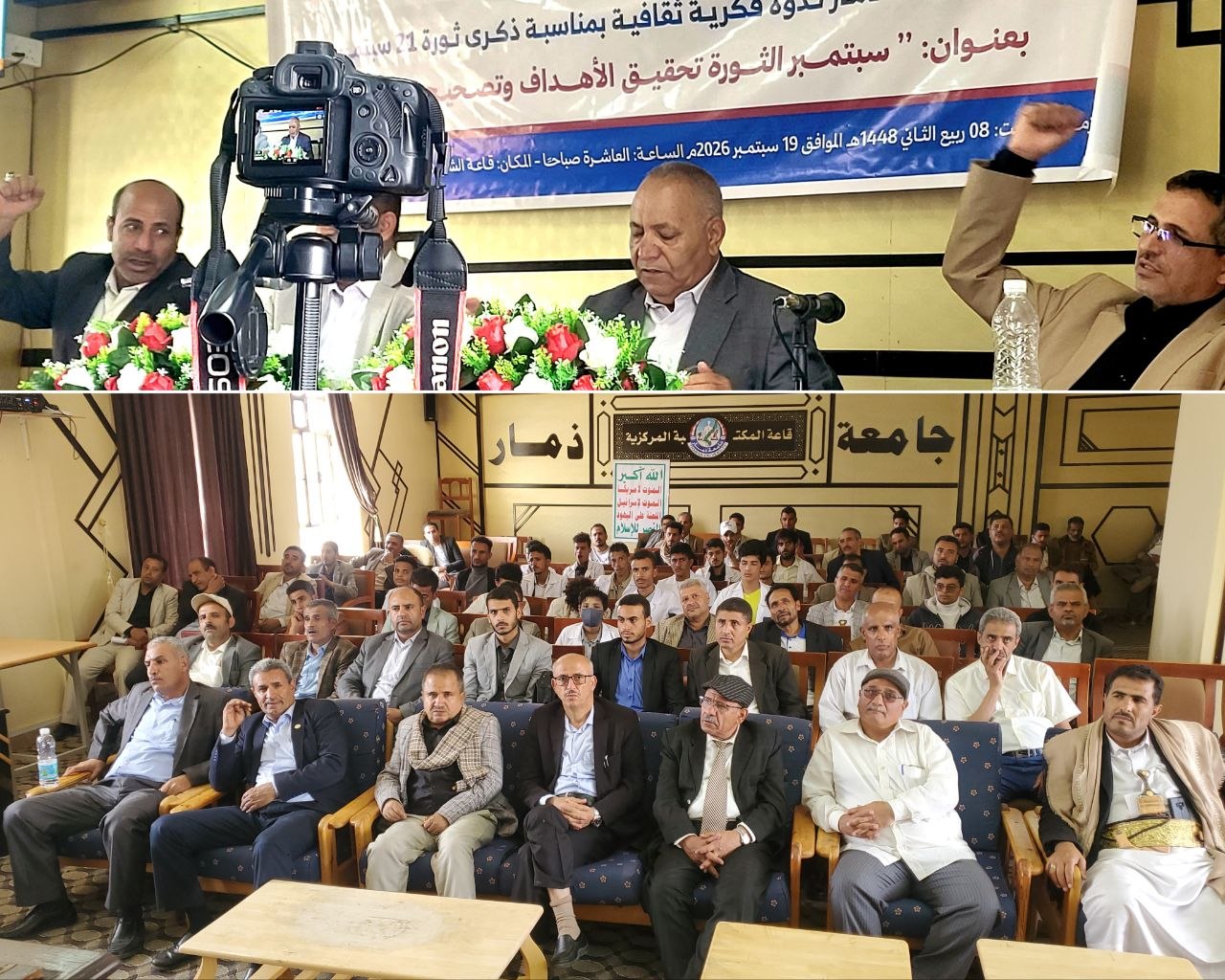
■ From the Martyr Al-Ghumari Hall in the Central Library, where the memory of national transformations intersects with the questions of the present and the prospects for the future, Thamar University commemorated the twelfth anniversary of the September 21 Revolution this morning through a symposium that discussed the revolution's goals, its trajectory, and its political and economic repercussions. The symposium was held under the patronage of Professor Dr. Mohammed Mohammed Al-Haifi, the Rector of the University.
The symposium, entitled "September Revolution: Achieving Goals and Correcting the Course," was attended by the University Rector, the Vice Dean of the Faculty of Administrative Sciences for Academic Affairs, and the University Rector's Consultant for Cultural Affairs. The sessions were moderated by the Assistant to the University Rector for Centers Affairs, Professor Dr. Essam Wasel.
At the outset of the symposium, the University Rector emphasized the importance of commemorating national occasions as opportunities to reflect on the trajectory of the national experience and to analyze the transformations Yemen has undergone, along with the associated political, economic, and social challenges. He then presented his paper, titled: “The September 21 Revolution in its Twelfth Year: From Ending Foreign Tutelage to Consolidating Regional Power Dynamics.”
The paper addressed the significance of September 21, 2014, as a pivotal moment in modern Yemeni history, focusing on its historical transition from a period of foreign tutelage to the strengthening of national sovereignty. It reviewed the decision for independence within the revolution's trajectory and the accompanying political, field, and regional transformations over the past twelve years.
The paper also discussed the Peace and Partnership Agreement and the positions of political, regional, and international powers at the time, as well as the shifts in Sana'a's position within the political and military landscape, and the repercussions of developments related to the Red Sea and Bab Al-Mandab Strait on regional and international dynamics.
From his part, Dr. Hussein Al-Munajar presented a paper titled: “ Yemeni Economy Between the Challenges of the Blockade and Indicators of Recovery and Industrial Localization.” In it, he addressed a range of economic indicators and data related to the performance of Yemeni economy over the past years, focusing on monetary and legislative policies, industrial localization, agriculture, food security, and the economic losses resulting from the war and the blockade.
Dr. Al-Munajar reviewed several economic measures that contributed to protecting the local currency and regulating commercial and investment activity. He referred to the Law on the Prohibition of Usurious Transactions and the new Investment Law No. (3) of 1446, and the investment incentives and facilities it included, as well as measures related to maritime and commercial activity.
He also discussed indicators of industrial localization, including a 13% reduction in the import bill, the licensing of 127 investment projects at a cost of $987 million, the reactivation of 14 major industrial facilities, and the addressing of the situations of struggling facilities.
On the agricultural front, the paper reviewed indicators of grain and legume production growth during the period 2015–2025, the expansion of wheat, maize, and soybean cultivation, as well as policies on contract farming and livestock protection, and related efforts to enhance food security and reduce dependence on imports.
The symposium concluded with a paper by Mr. Hassan Al-Mawshki, the Consultant of the University Rector for Cultural Affairs, who presented a comparative analysis of the objectives of the September 26, 1962, and September 21, 2014, revolutions. He highlighted the points of convergence between the two revolutions' goals, arguing that the September 21 revolution came to complete the objectives of the September 26 revolution, correct its course, and strengthen Yemeni decision-making independence and national sovereignty.
In his presentation, Mr. Al-Mawshaki emphasized that comparing the two revolutions should be understood within the context of the historical and political developments Yemen has undergone. He pointed out that the goals of independence, sovereignty, and protecting national decision-making represent a common thread running through the various stages of Yemen's national struggle. He also addressed the developments that followed the September 21 Revolution and the political leadership's stances on issues of sovereignty and independence.
The seminar was attended by the Vice-Rector for Student Affairs, Professor Dr. Abdulkafi Abdulfattah Al-Rifai, the Vice-Rector for Academic Affairs, Professor Dr. Adel Abdulghani Al-Ansi, the University General Secretary, Dr. Mohammed Hutrum, several deans of faculties and heads of departments, general directors, faculty secretaries, as well as academic and administrative leaders and staff, university students, and the Head of the Student Forum.
The seminar is part of the intellectual and cultural activities organized by Thamar University to commemorate the national milestones of the glorious September 21 Revolution.
https://t.me/tueduye/25227