2026-07-04
The Rector of Thamar University Chairs the First Annual Meeting of the Coordinating Council for the Universities, Colleges, and Institutes of Dhamar Governorate to Review Performance and Set Priorities for the Academic Year 1448
□ Thamar University Media | Muharram 19, 1448. July 4, 2026
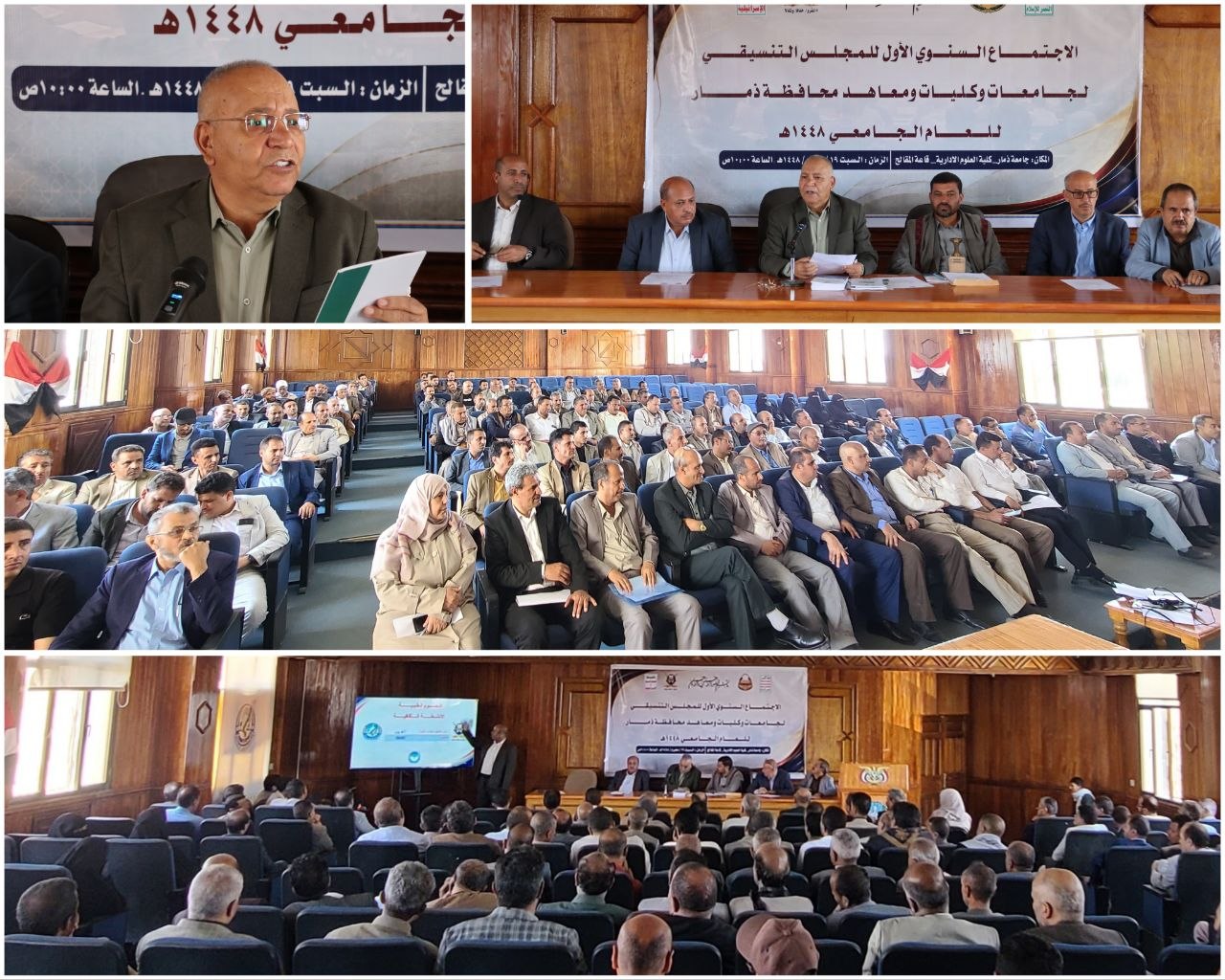
■ This morning, in the Al-Maqaleh Hall at the Faculty of Administrative Sciences, Thamar University, the first annual meeting of the Coordinating Council for the universities, colleges, and institutes of Dhamar Governorate for the academic year 1448 was held. The meeting was chaired by the Rector of Thamar University and the Head of the Coordinating Council, Professor Dr. Mohammed Al-Haifi, and participation from leaders of Thamar University and public and private higher education institutions and institutes in the governorate.
The purpose of the meeting was to review and evaluate the implementation of activities during the academic year 1447, examine performance indicators, identify shortcomings, and prioritize activities for the academic year 1448. This aims to contribute to developing institutional performance, enhancing the effectiveness of cultural, sports, mobilization, and national activities, and strengthening integration among higher education institutions in the governorate.
At the opening of the meeting, after listening to verses from the Holy Quran and standing for the national anthem, the Rector of Thamar University and the Chairman of the Coordinating Council, Professor Dr. Mohammed Al-Haifi, affirmed that cultural activity is a cornerstone of the educational process, given its role in consolidating faith-based identity, strengthening national awareness, and deepening engagement with the issues facing the nation. He emphasized the importance of adhering to a clear institutional vision and methodology for implementing cultural programs and events.
He also stressed the crucial role of student affairs offices in universities, colleges, and institutes, as well as other relevant units, in promoting cultural, awareness-raising, and mobilization programs, and in giving cultural and sports competitions greater attention and support, considering them an integral part of the educational system.
He explained that the council will focus in the coming phase on disseminating a unified map of religious, national, and cultural events. This will contribute to organizing work, unifying efforts, and enhancing integration among higher education institutions. He emphasized that faculty members are required to be at the forefront of participants and initiators in attending cultural events, given their impact on developing their knowledge and skills, enabling them to transfer this knowledge to students. This, in turn, strengthens their academic and educational mission and contributes to building a firm and balanced student awareness.
From his part, Mr. Ahmed Hussein Al-Dhurani, the Public Mobilization Officer in Dhamar Governorate, praised the increasing attention given by the leadership of Thamar University and the leadership of other universities, colleges, and institutes to cultural, awareness-raising, and mobilization aspects. He commended the level of interaction and coordination witnessed among higher education institutions in the governorate. He also reviewed the circular regarding the organization of graduation ceremonies, stressing the importance of adhering to its provisions.
Furthermore, he emphasized the necessity of maintaining the continuity of cultural, mobilization, and sports activities and expanding participation in them, given their importance in building the character of university students and strengthening the values of belonging, responsibility, and national awareness.
The meeting witnessed broad participation from Thamar University leaders, headed by the Vice Rector for Student Affairs, Professor Dr. Abdulkafi Al-Rifai, the Vice Rector for Graduate Studies and Scientific Research, Professor Dr. Abdulkarim Zabiba, the Vice Rector for Academic Affairs, Professor Dr.
Adel Abdulghani Al-Aansi, the Rector's Assistant to for Centers Affairs, Professor Dr. Essam Wasel, and the University General Secretary, Dr. Mohammed Hutrum.
The Dean of the College of Sharia and Law, Professor Dr. Abdulkarim Al-Bahla, the Dean of the College of Administrative Sciences, Professor Dr. Amal Al-Mujahid, the Dean of the College of Computer Science, Professor Dr. Bashir Al-Maqaleh, the Dean of the College of Education, Dr. Ahmed Al-Hadi, the Dean of the College of Arts, Dr. Amin Al-Jabr, the Dean of the College of Applied Sciences, Dr. Abdulqawi Al-Sharabi, the Dean of the College of Engineering, Dr. Fouad Al-Jermuzi, and the Dean of the Institute of Continuing Education, Professor Dr. Nabil Al-Mikhlafi were present. A number of vice deans, heads of academic departments, general directors, university leaders, and its academic and administrative staff also participated in the meeting.
The meeting reflected the broadening of coordination among higher education institutions in the province, with the participation of Dr. Amin Al-Salal, the Rector of Al-Hikma University, Dr. Fadhel Al-Sanabani, the of Genius University, Dr. Fayez Al-Harouji, the Dean of Al-Darb Community College, Dr. Hamoud Al-Mawshki, the Director of the Health Institute, Ahmed Al-Jarfi, the General Director of the Technical and Vocational Education and Training Office, Abdulkarim Zalaat, the Dean of the Industrial Institute, Nasser Al-Majhali, the Dean of the Commercial Institute, and Abdullah Al-Madoumi, the Dean of the Medical Association Institute. Representatives from the leadership of the remaining universities, colleges, and institutes also attended, clearly emphasizing the importance of unifying efforts, integrating roles, and exchanging expertise among the various higher education institutions to serve the development of the educational process, enhance its outcomes, and strengthen its national and societal mission.
This collaboration aims to achieve this goal. The meeting sessions were chaired by Mr. Hassan Al-Mawshki, the Consultant of the University Rector for Cultural Affairs, while Mohammed Bajah, the Head of the University Student Forum, presented the reports and reviewed the evaluation criteria. These criteria addressed the level of implementation of activities and programs during the academic year 1447, discussed mechanisms to address shortcomings, and ultimately approved a more effective plan and direction for the academic year 1448.
This plan aims to enhance the quality of institutional performance and solidify the presence of cultural, national, and sports activities as a cornerstone in building the university student's character, developing their awareness, and instilling values of belonging, identity and responsibility.