2026-06-21
Thamar University Launches its Cultural Activities for the New Academic Year 1448 with a Symposium on the Prophet's Migration
□ Thamar University Media / Muharram 6, 1448. June 21, 2026
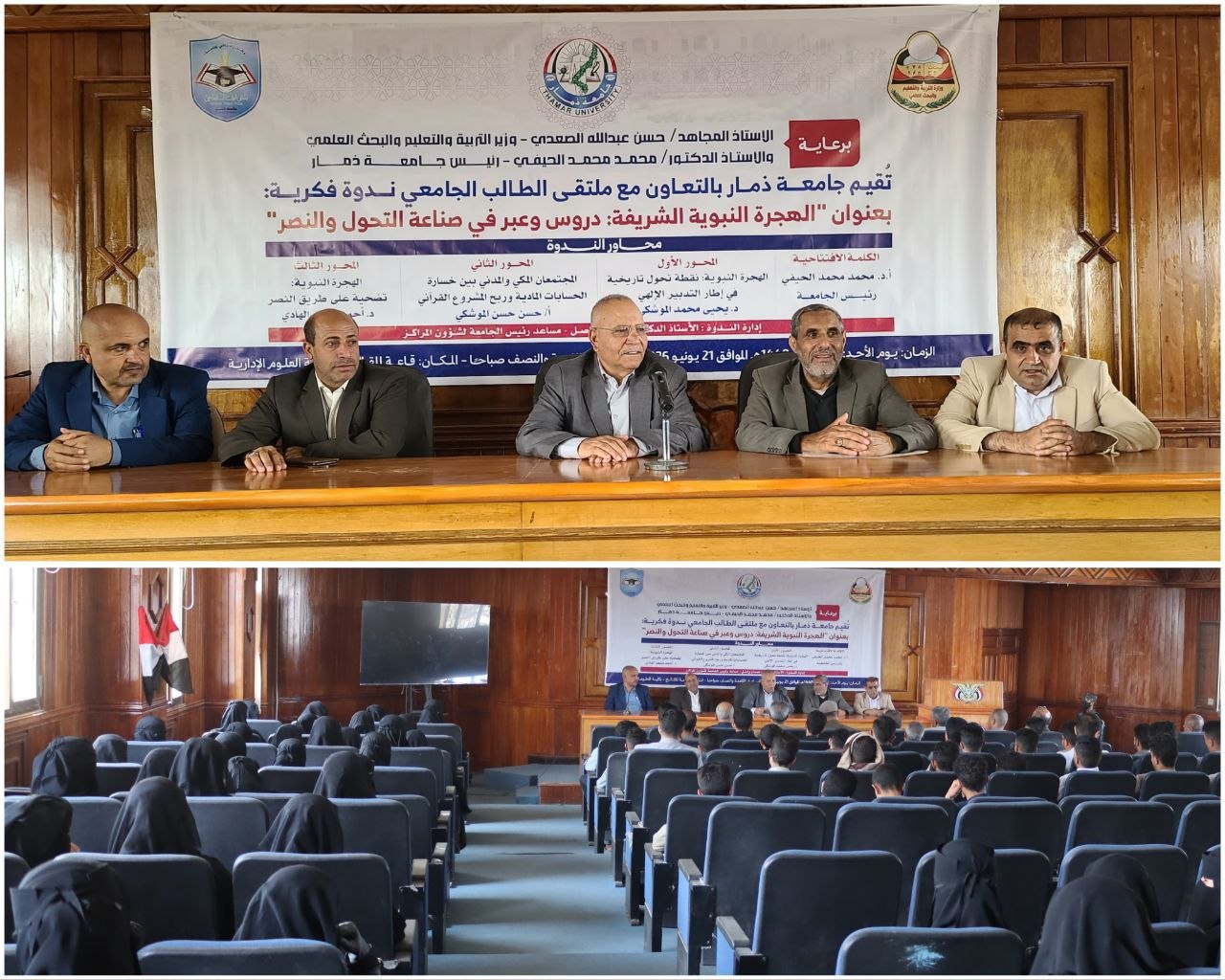
■ Drawing inspiration from the timeless lessons of the Prophet's migration, Thamar University, in cooperation with the University Student Forum, launched its activities for the new academic year with a symposium entitled "The Noble Prophetic Migration: Lessons and Insights in Creating Transformation and Victory."
The symposium was held under the patronage of Mr. Hassan Abdullah Al-Saadi, the Minister of Education and Scientific Research, and Dr. Mohammed Mohammed Al-Haifi, the Rector of Thamar University, and was attended by university leaders, deans of faculties, general directors, and a gathering of academics and students.
The symposium, moderated by Professor Dr. Essam Wasel, the Rector's Assistant for Centers Affairs, began with a recitation from the Holy Quran, followed by the opening address of Professor Dr. Mohammed Mohammed Al-Haifi, the Rector of the University.
He emphasized that inaugurating the new academic year with this cultural and faith-based event embodies the university's connection to pivotal events in Islamic history, foremost among them the Prophet's migration (Hijra), which represented a major turning point that altered the course of life and laid the foundation for the Islamic state based on God's religion, values, and great principles.
The first session of the symposium, presented by Dr. Yahya Mohamed Al-Mawshki, a faculty member at the university, entitled "The Prophet's Migration, A Historical Turning Point within the Framework of Divine Providence," addressed the strategic dimensions of the Prophet's migration. He explained that the move from Mecca to Medina was not a random event, but rather occurred according to profound divine wisdom. Mecca represented the initial starting point for the call to Islam, while Medina provided the ideal environment for building the state and consolidating the civilizational project of Islam.
He also pointed out that the Hijra (migration) represented the transition from a stage of weakness to a stage of empowerment, and that the success of the Islamic state and its ability to expand and endure despite increasing challenges, conspiracies, and confrontations was a fruit of this wise divine plan.
In the second session, titled "Meccan and Medinan Societies Between the Loss of Material Calculations and the Gain of the Quranic Project," Mr. Hassan Hassan Al-Mawshaki, the University Rector's Consultant for Cultural Affairs, reviewed the concept of substitution in light of the Prophet's biography. He also explained that the people of Mecca had a great opportunity to support the message of Mohammed, but they squandered it, thus transferring this honor to the people of Medina, the Aws and Khazraj tribes, who embraced the call and presented a unique model of support and sacrifice. He also touched upon the geographical and economic importance of Yathrib (Medina) and its strategic location on the trade route between Mecca and the Levant, explaining that these factors contributed to the success of the Islamic project and its expansion towards broader horizons.
Mr. Al-Mawshaki linked the historical role of Yemeni tribes of Aws and Khazraj in supporting Islam to the stances of Yemenis today and throughout different historical periods. He reviewed what he described as the enduring spirit of support and solidarity in contemporary positions regarding the issues facing the Muslim world, emphasizing that will, faith, and awareness of the cause of truth are decisive factors in bringing about major transformations, regardless of how limited material resources may be compared to others.
The third presentation, delivered by Dr.
Ahmed Musad Al-Hadi, the Dean of the Faculty of Education, entitled "The Prophetic Migration, A Sacrifice on the Path to Victory," highlighted the magnitude of the sacrifices made by the Prophet Mohammed (peace and blessings be upon him and his family) in conveying the message. He reviewed the pressures, temptations, and compromises he faced, which he steadfastly and faithfully rejected. He also explained that the mission of spreading the message was characterized by patience in the face of distortion, insults, media campaigns, and relentless targeting, and that the bearer of the message must shoulder heavy burdens without yielding to challenges and conspiracies.
Dr. Al-Hadi pointed out that the Prophet's migration embodied the highest ideals of selflessness and sacrifice, citing the example of Imam Ali ibn Abi Talib (peace be upon him), who set a unique example of selflessness by sleeping in the Prophet's bed on the night of the migration. He emphasized that true victory is achieved only through patience, steadfastness, and a willingness to sacrifice for the sake of principles and values.
The symposium was attended by Professor Dr. Abdulkafi Al-Rifai, the Vice-Rector of the University for Student Affairs, Professor Dr. Adel Al-Ansi, the Vice-Rector of the University for Academic Affairs, Dr. Mohammed Hutrum, the General Secretary of the University, and a number of deans, vice deans, department heads, general directors of public administrations, and university leaders and staff, who affirmed the importance of these intellectual and cultural events in raising awareness of the values of the Prophet's migration and drawing lessons from it in confronting challenges and building the future.