The Rector of Thamar University Inaugurates the Graduation Project Presentations for the Third Graduating Class of the Mechatronics Engineering Department and Emphasizes the Importance of Transforming Innovation into Solutions that Serve Development
The Rector of Thamar University Inaugurates the Graduation Project Presentations for the Third Graduating Class of the Mechatronics Engineering Department and Emphasizes the Importance of Transforming Innovation into Solutions that Serve Development
□ Thamar University Media | Muharram 20, 1448. July 5, 2026
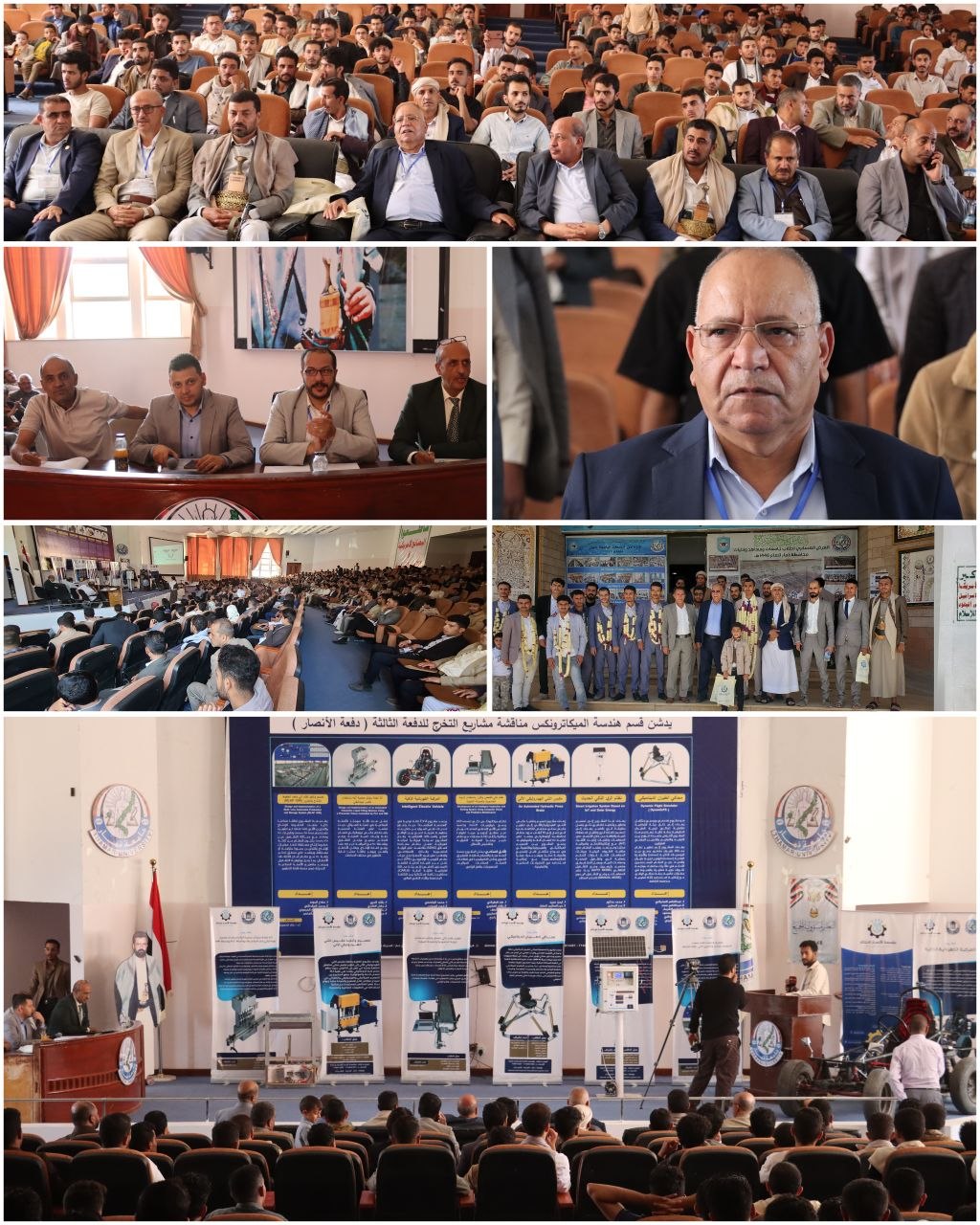
■ Under the patronage of the Rector of Thamar University, Professor Dr. Mohammed Al-Haifi, the graduation project presentations for the third graduating class (Al-Ansar Class) of the Mechatronics Engineering Department at the Faculty of Engineering were inaugurated this morning in the Palestine Hall. The event was attended by university and faculty leaders, representatives from the University Student Forum, and the Ansar Foundation for Innovation and Capacity Building.
This scientific event showcased the high level of academic qualification achieved by the students of the department and reflected the university's commitment to promoting scientific research and aligning educational outcomes with the needs of development and the labor market.
In his opening remarks, the University Rector emphasized that the graduation project presentations represent a significant academic milestone, culminating years of hard work, dedication, and training. He noted that they also mark the beginning of a new phase, as graduates transition into the fields of work, production, and innovation. He pointed out that mechatronics engineering is among the most prominent specializations of the future, given its integration of mechanical, electrical, and electronic engineering, as well as control systems, programming, and artificial intelligence. This integration, he explained, qualifies graduates to contribute to the development of various industrial, medical, agricultural, and service sectors.
He further stated that the university places great importance on specialized fields that contribute to knowledge creation and technology localization. He urged students to continue developing their projects, transforming them into practical and applicable products and solutions, and to uphold the values of excellence, teamwork, and continuous improvement in their scientific and professional skills. This, he concluded, will make them distinguished ambassadors for Thamar University in the fields of work and innovation.
In the same vein, Professor Abdulkafi Al-Rifai, the Vice-Rector of Thamar University for Student Affairs, affirmed that graduation projects represent the true indicator of the quality of academic output and embody students' ability to apply their theoretical knowledge to create innovative engineering solutions that serve society and meet development needs. He pointed out that Thamar University places great importance on fostering student creativity and innovation by supporting scientific and research activities, encouraging applied projects, and strengthening their connection to labor market needs. This contributes to preparing engineers who possess scientific and practical competence, capable of competing and contributing to the nation's progress and development.
From his part, Mr. Ahmed Hussein Al-Dhurani, the Public Mobilization Officer in Dhamar Governorate, emphasized the importance of supporting engineering, productive, and innovative projects and linking them to development needs and the labor market. This contributes to building a national economy based on knowledge and production. He commended the university leadership and the college deanship for their attention to student innovations and praised the efforts of the judging and supervisory committees in ensuring the success of this scientific event.
At the opening ceremony, a speech was delivered on behalf of the Al-Ansar Foundation, the external sponsor of the projects. The Foundation affirmed its continued support for scientific initiatives and student innovations, and its encouragement of creative university students, contributing to the transformation of outstanding ideas into practical projects capable of serving the community and fostering a culture of innovation
and productivity.
From his part, the Dean of the College of Engineering, Dr. Fouad Al-Jermouzi, explained that the graduation project presentations represent the culmination of years of academic study and practical application. They embody the student's transition from acquiring knowledge to applying it in providing realistic engineering solutions. He emphasized that the college continues to develop its academic programs to keep pace with scientific advancements and meet the needs of the job market.
Students from the Mechatronics Engineering Department showcased seven high-quality graduation projects that reflected an advanced level of engineering and technical skills. These projects included a dynamic flight simulator, a smart irrigation system based on the Internet of Things and solar energy, an automated hydraulic bending press, an intelligent inspection and sorting system using computer vision and predictive maintenance, a self-driving electric vehicle, an automated volumetric filling machine using industrial control systems, and a multi-line automated production and storage system. These projects addressed advanced applications in the fields of industrial automation, robotics, artificial intelligence, computer vision, renewable energy, and intelligent control, demonstrating the students' ability to apply their academic knowledge to design innovative engineering solutions that meet real-world needs.
The opening session of the discussions was attended by the Vice-Rector for Student Affairs, Professor Dr. Abdulkafi Al-Rifai, the Vice-Rector for Graduate Studies and Scientific Research, Professor Dr. Abdulkarim Zabiba, the Vice-Rector for Academic Affairs, Professor Dr. Adel Abdulghani Al-Ansi, the Rector's Assistant for Centers Affairs, Professor Dr. Essam Wasel, the University General Secretary, Dr. Mohammed Hutrum, as well as a number of university leaders, faculty members, students, parents, and other interested parties.
The discussion committee, comprised of the Dean of the College of Engineering, Dr. Fouad Al-Jermouzi, Dr. Khaled Al-Husseini, the Consultant of the University Rector for Automation Affairs, Mohammed Al-Madwahi, the Head of the Mechatronics Engineering Department, and Dr. Abduljabbar Al-Ayani, a faculty member at the college, evaluated the scientific projects according to academic standards. This evaluation aimed to encourage the project owners to further develop their work, thereby strengthening the university's role in fostering creativity and innovation and preparing qualified engineering professionals capable of contributing to the nation's development and serving its citizens.