Thamar University Concludes Training Course on Building a University Center System and Issues a Set of Development Recommendations
□ Thamar University Media / Rabi Al-Thani 17, 1448. September 28, 2026
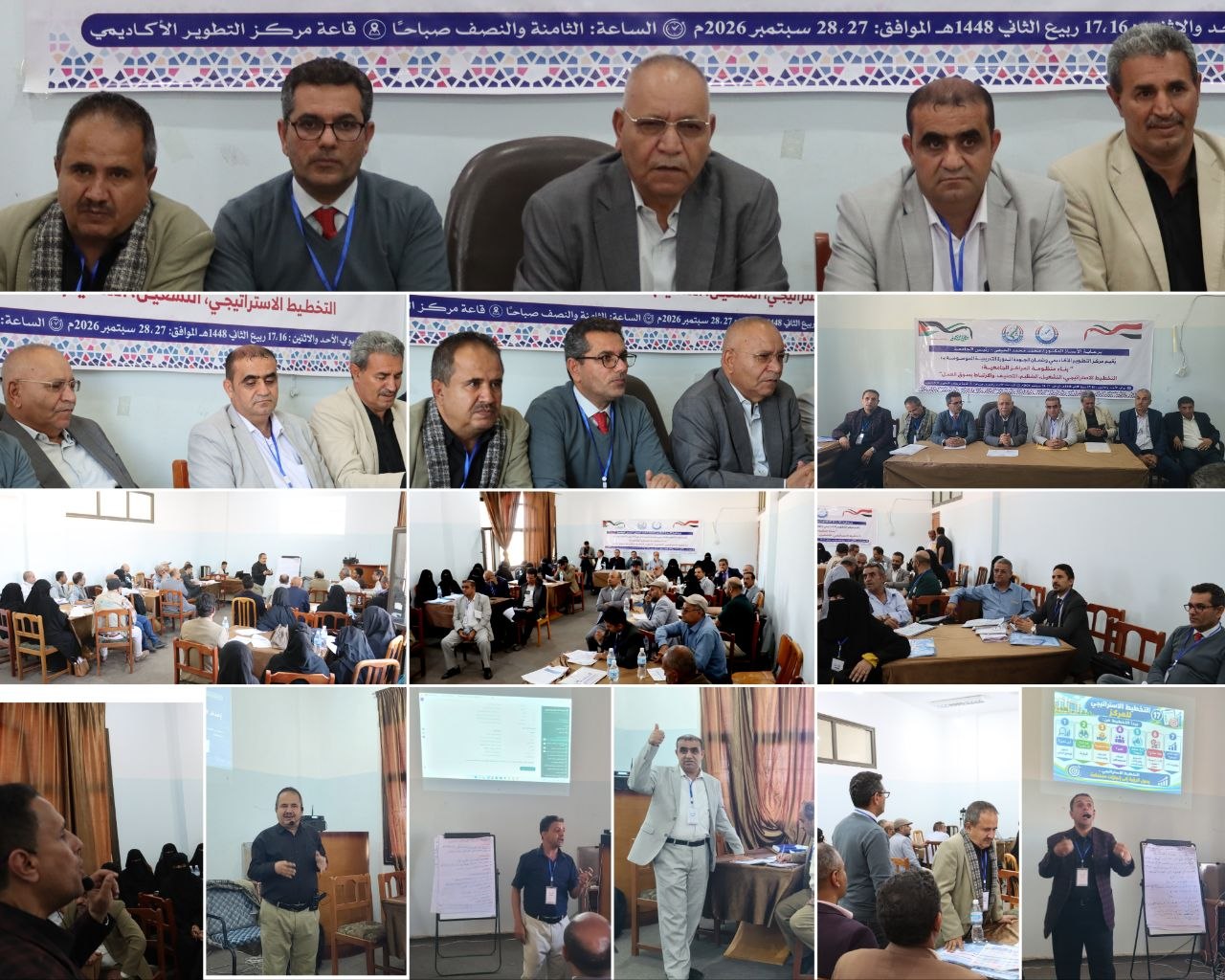
■ Thamar University concluded this afternoon the training course entitled "Building a University Center System," organized by the Academic Development and Quality Assurance Center and the University's Centers Sector. The two-day course was attended by 45 trainees from university leadership and staff members of the university centers, representing 11 of the university's centers.
At the closing ceremony, Professor Dr. Mohammed Mohammed Al-Haifi, the Rector of Thamar University, emphasized the importance of the topics covered in the course related to building an integrated institutional system for university centers, which enhances their effectiveness and improves their performance. He wished the participants success in applying the course's outcomes and translating them into practical procedures that contribute to developing the centers' institutional work, services, and programs.
From his part, the Rector's Assistant for Centers Affairs, Professor Dr. Essam Hefzallah Wasel, commended the University Rector's commitment to holding the workshop, which established a framework for effective governance that will elevate the management of the university's centers. He also expressed his gratitude to the Center for Academic Development and Quality Assurance, the trainers, and the participants for their efforts in ensuring the success of the training program. He emphasized the importance of translating the course's outcomes from theoretical knowledge and training into practical application, thereby strengthening the role of the centers in serving the university, the needs of the community, and the job market.
The second day of the training program included three main sessions. Dr. Munir Mohammed Al-Sabahi addressed the first topic: performance indicators and monitoring. He reviewed the concept of Key Performance Indicators (KPIs), their types, mechanisms for selecting appropriate indicators for objectives, and methods for monitoring plan implementation and measuring achievement levels. This was followed by a practical activity to design performance indicators for operational objectives, and then presentations by the groups and a discussion of the proposed indicators.
Associate Professor Dr. Rashid Mohammed Al-Sanfi addressed the topic of classifying university centers and mechanisms for linking them to the labor market. He discussed the concept of classification, its importance and criteria, the levels of institutional maturity of centers, ways to align center services and programs with labor market needs, studying the needs of different sectors, building partnerships with external entities, and developing programs and services. This session included a group activity to evaluate a university center according to classification criteria and determine its level, followed by a presentation and discussion of the results.
The second day concluded with a session presented by Professor Dr. Adel Abdulghani Al-Ansi on a guide for preparing internal regulations for centers. He addressed the principles governing the preparation of internal regulations, in addition to a practical activity to develop a draft of internal regulations for each center, tailored to its specialization and tasks.
The closing session included an evaluation of the training program, a review of its key outcomes, answers to participants' inquiries, and a discussion of proposals and recommendations for development and improvement, all aimed at enhancing the practical application of the course's themes.
At the closing ceremony, Dr. Waleed Ahmed Dahia, the Dean of the Center for Academic Development and Quality Assurance, presented the recommendations that emerged from the training course.
Foremost among these was the necessity of developing strategic directions for university centers that align with the university's objectives and general orientations, and of creating clear, time-bound operational plans that translate these directions into implementable programs and projects that can be monitored and evaluated.
The recommendations also emphasized the importance of developing internal regulations governing the work of each center, derived from the central, general regulations for all centers, while taking into account the nature of each center's specialization and tasks. Furthermore, the recommendations stressed the need to develop classification literature and standards specific to the centers to contribute to their organization, define their levels and specializations, and enhance their performance efficiency.
The course also recommended adopting simultaneous electronic and paper archiving for all indexable documents, data, and records. This ensures their preservation, organization, and ease of retrieval, and supports the institutional and digital transformation in the management of university centers.
The event concluded with the honoring of the course participants and the presentation of certificates of appreciation in recognition of their participation in the training program and their commitment to developing the institutional performance of university centers. The closing ceremony was attended by the University General Secretary, Dr. Mohammed Hutrum, the General Secretary of the Center for Academic Development and Quality Assurance, Nasser Najad, and a number of university leaders and staff members from university centers.
https://t.me/tueduye/25487