Thamar University Discusses Scientific Study Guidelines and Their Evaluation to Enhance the Quality of Executive Graduate Programs
Thamar University Discusses Scientific Study Guidelines and Their Evaluation to Enhance the Quality of Executive Graduate Programs
□ Thamar University Media / Rabi Al-Thani 19, 1448. September 30, 2026
■ In a step aimed at elevating the executive graduate studies track and linking its outcomes to research needs and the labor market, Thamar University discussed the guidelines for preparing and evaluating scientific studies for executive master's and doctoral programs at the Faculty of Administrative Sciences. The workshop brought together academic leaders, researchers, representatives of governmental and professional bodies, experts, and practitioners to examine the philosophy behind these guidelines, their components, and the criteria for evaluating scientific studies and their outcomes.
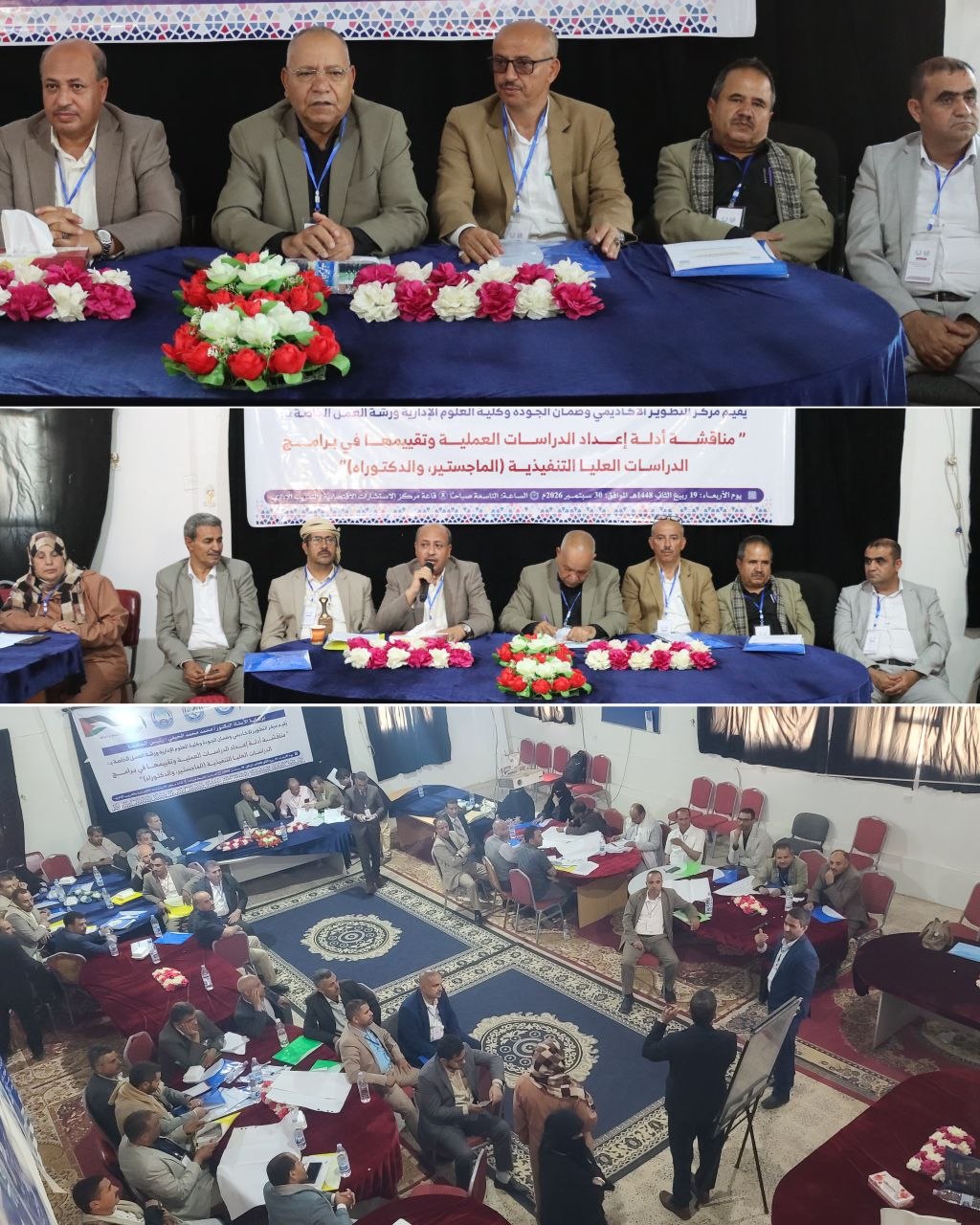
Under the patronage of Professor Dr. Mohammed Mohammed Al-Haifi, the Rector of Thamar University, the Academic Development and Quality Assurance Center and the Faculty of Administrative Sciences organized a workshop this morning entitled "Discussing the Guidelines for Preparing and Evaluating Scientific Studies in Executive Graduate Programs (Master's and Doctoral)," held in the hall of the Center for Economic Studies, Consulting, and Administrative Training at the university.
The Unversity Rector, Professor Dr. Mohammed Mohammed Al-Haifi emphasized the importance of developing and enhancing the quality of graduate programs to meet academic accreditation requirements. He noted the university's focus this year on fulfilling the accreditation requirements for several of its colleges, which will strengthen the quality of the educational and research process and elevate its outcomes.
From his part, the Vice President for Graduate Studies and Scientific Research, Professor Dr. Abdulkarim Ismail Zabiba, stressed the importance of unifying the vision regarding the preparation and evaluation of scientific studies and achieving alignment between graduate programs and the university's research paths. This will ensure that scientific research proceeds according to a clear roadmap that responds to scientific and developmental priorities and connects studies to the needs of society and its institutions.
The Dean of the Faculty of Administrative Sciences, Professor Dr. Amal Mohammed Al-Mujahid, welcomed the participants, reviewing the faculty's and university's experience with executive graduate programs. She pointed out that Thamar University was among the first Yemeni universities to launch these programs in 2007, initially under the name "Functional Programs," before the program evolved and its scope expanded.
The workshop began with a recitation from the Holy Quran. The scientific sessions included an introduction to the workshop's objectives, working methods, and discussion framework, presented by Dr. Waleed Ahmed Dahya, the Dean of the Center for Academic Development and Quality Assurance. This was followed by a presentation from Dr. Hussein Al-Shaari, the Head of the Business Administration Department, on executive programs and their targeted learning outcomes.
Dr. Abdulkarim Ahmed Al-Dailami, the Head of the Quality Unit at the College of Administrative Sciences, addressed the central question of what supplementary research should produce to fulfill the requirements for Master's and Executive Doctoral degrees, and the nature of the expected scientific and applied outputs from these programs.
Professor Dr. Amal Al-Mujahid, the Dean of the College of Administrative Sciences, presented on the philosophy and components of the guide for preparing and evaluating scientific studies, and answered participants' related inquiries and comments.
After a break, the workshop resumed with a discussion session moderated by theHead of the Measurement and Evaluation Unit, Dr.
Ahmed Musad Al-Hadi who focused on the aspirations and opinions of representatives from local authorities, the Ministry, experts, practitioners, and representatives of governmental and professional bodies, aiming to enrich the proposed guidelines and strengthen their relevance to practical realities and labor market needs.
The workshop concluded with a presentation of its outputs and final recommendations by Dr. Abdulkarim Al-Dailami, the Head of the Quality Unit at the College. These recommendations included the necessity of strengthening partnership and integration between the university and local authorities, expanding consultation channels with governmental and professional bodies to identify field problems and challenges and their actual needs, and directing studies and research in executive master's and doctoral programs toward analyzing these issues and proposing practical and applicable solutions. Certificates of appreciation were distributed to the organizers, trainers, and participants.
The event was attended by the Vice Rector for Student Affairs, Professor Abdulkafi Al-Rifai, the Vice-Rector for Academic Affairs, Professor Adel Abdulghani Al-Ansi, and the Rector's Assistant for Centers Affairs, Professor Dr. Essam Wasel, the University General Secretary, Dr. Mohammed Hutrum, the Deputy Governor Ahmed Al-Dhurani representing the local authority, the General Secretary of the Faculty of Administrative Sciences Abdullah Rajih, the General Secretary of the Academic Development Center Nasser Najad, the General Secretary of the Center for Economic Studies, Consulting, and Administrative Training Hanaa Al-Rasabi, as well as a group of researchers and stakeholders from the local authority, executive offices, and the labor market.
https://t.me/tueduye/25617