Thamar University Updates Master's Programs in Applied Sciences with a Specialized Workshop to Enhance Quality and Academic Accreditation for Zoology, Microbiology and Aquatic Resources Programs
Thamar University Updates Master's Programs in Applied Sciences with a Specialized Workshop to Enhance Quality and Academic Accreditation for Zoology, Microbiology and Aquatic Resources Programs
□ Thamar University Media / Jamal Al-Bahri / Shaaban 21, 1447. February 9, 2026
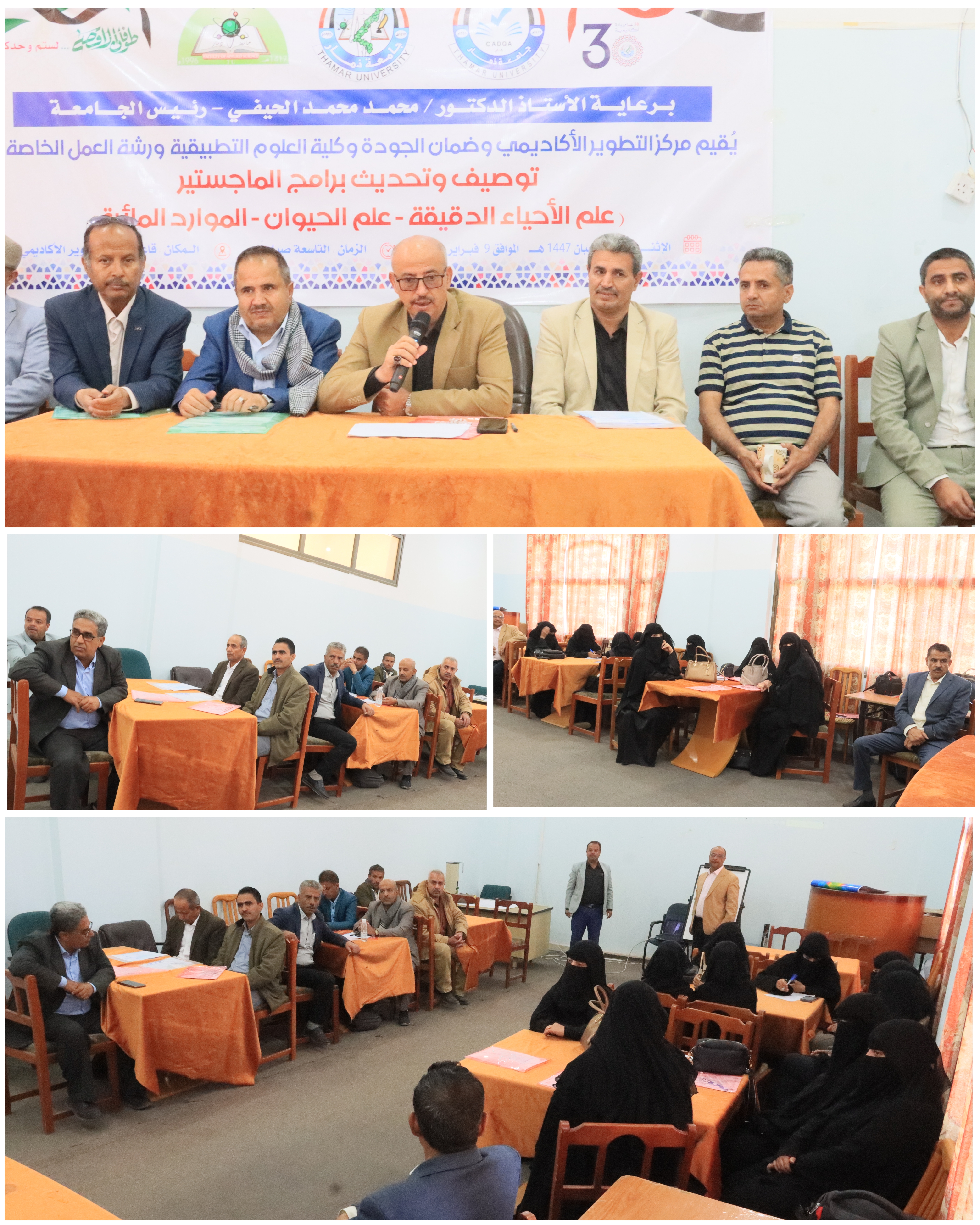
■ As a part of its postgraduate development initiative, Thamar University, represented by the Center for Academic Development and Quality Assurance and the Faculty of Applied Sciences, organized a specialized scientific workshop to define the Master's programs in Microbiology, Zoology, and Aquatic Resources.
The workshop was held under the patronage of the University Rector, Professor Dr. Mohammed Mohammed Hassan Al-Haifi, in line with strategic directions aimed at raising the quality of academic output, enhancing the efficiency of research programs, and linking them to development needs and vital sectors.
During the opening session, the Vice-Rector for Student Affairs, Professor Dr. Abdulkafi Abdulfattah Al-Rifai, emphasized that updating the Master's programs represents a direct investment in building students' scientific capabilities and providing them with advanced specialized training.
He pointed out that specialized programs based on precise descriptions and clear learning outcomes contribute to expanding students' research and applied opportunities and support linking academic knowledge to the needs of society and the productive and service sectors.
Dr. Al-Rifai praised the remarkable achievement of the Deanship of Graduate Studies and Scientific Research over the past three years, emphasizing that this progress resulted from fruitful institutional cooperation between the Deanship of Graduate Studies and the Center for Academic Development and Quality Assurance.
He affirmed that this level of outstanding performance would not have been possible without the support and efforts of the University Rector, Professor Dr. Mohammed Al-Haifi, and the supportive environment he fostered, along with seamless coordination, the removal of obstacles, the empowerment of relevant parties and the provision of necessary resources.
From his part, the Dean of the Center for Academic Development and Quality Assurance, Vice-Rector for Academic Affairs Professor Dr. Adel Abdulghani Al-Ansi, explained that the program specification process is a procedural approach to ensuring the quality of academic performance.
It includes reviewing the mission and objectives, developing learning outcomes and aligning them with national academic accreditation standards, as well as updating study plans, integrating theoretical and practical aspects, and ensuring continuous improvement according to approved institutional evaluation models.
From his part, the Dean of the College of Applied Sciences, Dr. Abdulqawi Dabwan, welcomed the attendees, including academic leaders, faculty members, and specialists.
He explained that updating and launching master's programs in these specializations represents a strategic step that serves the local environment, the health, veterinary, and water sectors. This initiative contributes to preparing qualified personnel capable of addressing the challenges associated with infectious diseases, antibiotic resistance, animal production and water resource management, thereby enhancing self-sufficiency and supporting food and health security.
The workshop included a series of presentations detailing the three master's programs. These presentations covered the structure of the study plans, required and elective courses, admission and graduation requirements, and practical training in laboratories, farms and health centers.
The presentations also addressed the human resources requirements, including specialized faculty members, and the material requirements, such as laboratories, equipment, and specialized devices. Finally, they presented local standards for ensuring the quality of academic programs and the mechanisms for review and accreditation.
The workshop included several scientific sessions and specialized presentations delivered by a select group of academics. It opened with a session outlining the workshop's objectives and themes, presented by Professor Dr. Adel Abdulqhani Al-Ansi.
This was followed by a presentation on the Master's program in Microbiology by Associate Professor Dr. Fouad Ahmed Ali Saad, and then a presentation on the Master's program in Zoology by Professor Dr. Abdualhalim Salem Al-Tamimi. Professor Dr. Ayman Abdulsabour Ahmed Khalaf then presented the Master's program in Water Resources. Dr. Abdulkareem Mohammed Al-Moshki also gave a detailed presentation on learning outcomes and their alignment with objectives, standards, and admission and graduation requirements.
The sessions concluded with a discussion of improvement proposals, quality assurance, continuous evaluation, and the formulation and approval of recommendations. This session was facilitated by the Academic Development and Quality Assurance Center team and the relevant scientific committees.
The workshop witnessed an official and academic presence, as well as representatives of students and the labor market, including the Dean of the Faculty of Medical Sciences, Dr. Adel Emran, the General Secretary of the University, Dr. Mohammed Hutrum, the General Director of Graduate Studies, Abdu Al-Marani, the General Secretaries of the Center, Mr. Nasser Najad, and the College, Abdualwali Al-Bariq, and a number of heads of units and departments, faculty members, and specialists in program description and quality assurance, in a participation that reflected an integrated institutional interest in developing graduate studies programs and raising their efficiency.